The Best BRI and BMI Calculator for Free!

Free, fast, and reliable BRI and BMI calculator.

⚕️ For informational purposes only. Not medical advice. Consult a healthcare professional for health decisions.

Calculate Your Body Roundness Index

🔒 Privacy: All calculations happen in your browser. We never send or store your measurements.

What is BRI or Body Roundness Index?

Body Roundness Index (BRI) is a modern measure of body shape that considers both height and waist circumference. This body roundness calculator provides an accurate estimate of body fat distribution, helping you understand potential health risks.

Why BRI Matters for Your Health Status

Unlike traditional measurements, BRI accounts for where your body stores fat. This is crucial because visceral fat (fat around your organs) poses greater health risks than fat stored elsewhere. BRI gives you insights that simple weight measurements can't provide.

Why Use This Body Roundness Calculator?

Our free BRI calculator provides a more comprehensive health condition assessment than BMI alone. It's 100% free, requires no signup, and all calculations happen privately in your browser. Get professional-level body composition insights instantly.

How to Calculate Body Roundness Index

Want to calculate your body roundness index? It's easier than you think! Our calculator does the complex math instantly, but here's how the calculation works behind the scenes.

The B.R.I. Formula Explained

The Body Roundness Index uses a mathematical formula that combines your waist circumference and height (measured in meters):

BRI = 364.2 - (365.5 * √(1 - ((0.5 * waist / (0.5 * height))² / (2 * π))))

Understanding the Formula Simply

In simple terms, the B.R.I. formula assesses how round your body shape is relative to your height. A higher score indicates more body roundness, which correlates with increased visceral fat and potential health risks. The beauty of this free BRI calculator is that you don't need to do the math manually—just enter your measurements above!

How to use BRI Calculator?

  1. Select the measurement system you prefer: Metric (cm) or Imperial (inches).
  2. Enter your waist circumference and height. See The Accurately Measuring Your waist section.
  3. Click the "Calculate BRI" button to get your Body Roundness Index.
  4. Review your results to understand your body composition better.

Understanding Your BRI Scale and Score

Once you calculate your body roundness index, you'll receive a BRI score that falls somewhere on the BRI scale. This score helps you assess your current health status and identify areas for improvement.

What the BRI Scale Tells You

The BRI scale ranges from very lean (low scores) to high body roundness (elevated scores). Here's what different ranges typically indicate:

  • BRI score under 3.4: Very lean body shape - generally indicates low health risk from body fat distribution
  • BRI score 3.4-4.45: Healthy range - indicates balanced body composition with lower health risks
  • BRI score 4.45-5.45: Above average - suggests monitoring your health condition and lifestyle habits
  • BRI score 5.46-6.90: High body roundness - indicates increased health risks requiring attention
  • BRI score above 6.90: Very high - strongly suggests consulting a healthcare professional for body fat percentage assessment

Think of your BRI score like a health snapshot. It reveals patterns in your body composition that simple weight measurements miss. Ready to calculate my body roundness index? Use the calculator above to get your personalized BRI score instantly!

Guide: Accurately Measuring Your waist

  1. Use a flexible measuring tape. Upgrade to professional-grade precision measuring tape →
  2. Stand up straight and locate your natural waist (the narrowest part of your torso, usually just above your belly button).
  3. Wrap the tape around your waist horizontally, keeping it parallel to the floor.
  4. Make sure the tape is snug but not too tight - you should be able to fit one finger underneath.
  5. Don't hold your breath or suck in your stomach while measuring.
  6. Record the measurement in centimeters or inches, depending on your preferred unit.
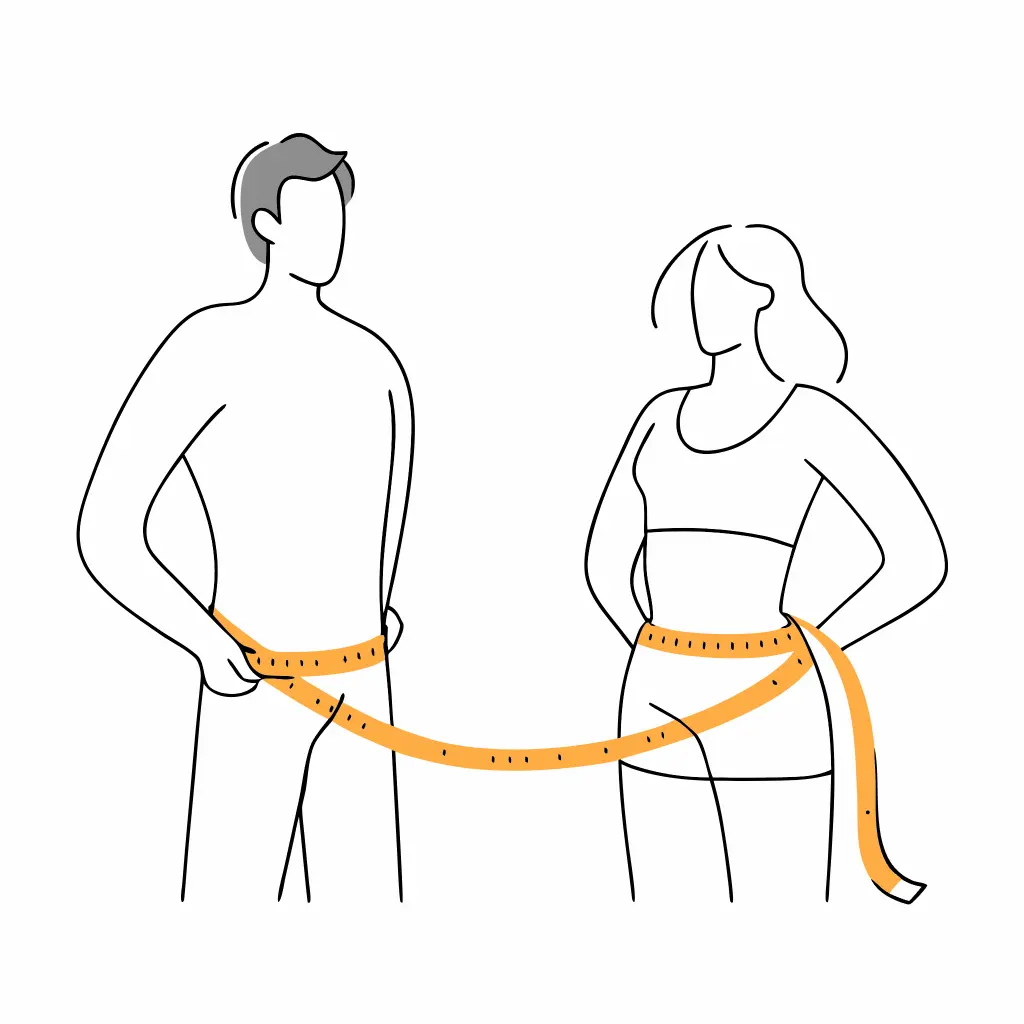
Waist circumference measurement guide showing different body types

Visual guide showing waist circumference measurements for both sexes

Frequently Asked Questions

BMI does not differentiate between muscle and fat mass, leading to potential misclassification. For example, muscular individuals may be categorized as overweight or obese, while those with low muscle mass but high body fat may fall within a "normal" range. It also does not account for fat distribution, which is important in assessing health risks.

BRI reveals important information about your body shape and how fat is distributed throughout your body. This matters because where you store fat significantly impacts your health risks. The BRI scale helps assess your overall health status beyond just your weight.

BRI is particularly useful for estimating visceral fat—the dangerous fat stored around your internal organs. Unlike body fat percentage measurements that require special equipment, this body roundness calculator provides an accessible way to assess visceral fat levels. Higher BRI scores often indicate more visceral fat, which is linked to increased risks of heart disease, diabetes, and other serious health conditions.

Unlike BMI, BRI takes into account body shape by incorporating waist circumference, providing a more comprehensive assessment of body composition.

A BRI value between 3.4 and 4.45 is generally considered normal, with values above 5 indicating increased health risks.

The World Health Organization (WHO) defines a healthy BMI range as 18.5 to 24.9. A BMI below 18.5 is considered underweight, 25 to 29.9 is overweight, and 30 or above is classified as obese.

Yes, BRI can be used to predict health risks such as cardiovascular disease, diabetes, and metabolic syndrome. By considering waist circumference, it provides insight into abdominal fat, which is more closely associated with these conditions than overall body weight alone.

BRI is considered more accurate than BMI for estimating health risks associated with body fat, as it incorporates waist circumference to better reflect fat distribution. However, both are useful tools, and their effectiveness may vary depending on individual circumstances. Combining them with other health assessments can provide a more comprehensive evaluation.

Waist circumference is a useful indicator of health risk, particularly for assessing abdominal fat, which is linked to conditions like heart disease and diabetes. However, using it in combination with other measures like BMI or BRI can provide a more comprehensive evaluation of health risks.

BMI is widely used because it is simple, quick to calculate using only height and weight, and cost-effective for population-level screening. Developed in 1832 and adopted by WHO, it provides a standardized method to identify weight categories that correlate with health risks.

BMI is a useful screening tool but not perfectly accurate. It cannot distinguish between muscle and fat mass or account for fat distribution. Athletes may score as overweight despite being healthy, while others may have normal BMI but excess abdominal fat. For individual assessment, combine BMI with other measures like BRI.

BRI is generally more accurate than BMI for assessing obesity-related health risks because it incorporates waist circumference, which reflects abdominal fat distribution. Abdominal fat is more strongly linked to cardiovascular disease and diabetes than overall body weight alone. Using both provides the most comprehensive assessment.

References for Body Roundness Index

Scientific sources supporting our Body Roundness Index (BRI) calculator

1

Thomas, D. M., et al. (2013).

Relationships between body roundness with body fat and visceral adipose tissue emerging from a new geometrical model

Obesity, 21(11), 2264-2271.

This foundational study introduced the Body Roundness Index as a novel anthropometric measure for assessing body shape and predicting visceral adipose tissue distribution.

2

Chang, Y., et al. (2018).

Body roundness index and its association with metabolic syndrome in type 2 diabetes mellitus

Diabetes, Metabolic Syndrome and Obesity: Targets and Therapy, 11, 827-833.

Research demonstrating BRI's effectiveness in identifying metabolic syndrome risk in patients with type 2 diabetes, showing superior predictive value compared to BMI.

3

Perona, J. S., et al. (2019).

Waist circumference and abdominal volume index are the strongest anthropometric discriminators of metabolic syndrome in Spanish adolescents

European Journal of Clinical Investigation, 49(3), e13060.

Study validating waist-based measurements including BRI components for assessing metabolic health risks in younger populations.

4

Rico-Martín, S., et al. (2020).

Effectiveness of body roundness index in predicting metabolic syndrome: A systematic review and meta-analysis

Obesity Reviews, 21(9), e13023.

Comprehensive meta-analysis confirming BRI's superior accuracy in predicting metabolic syndrome across diverse populations compared to traditional anthropometric measures.

5

Zhang X, Ma N, Lin Q, et al. (2024)

Body Roundness Index and All-Cause Mortality Among US Adults

JAMA Netw Open, 2024;7(6):e2415051.

the application of BRI as a noninvasive and easy to obtain screening tool for estimation of mortality risk and identification of high-risk individuals.